Southern Smothered Pork Chops – The Onion Gravy Secret That Makes Them Taste Like Sunday Dinner at Grandma’s
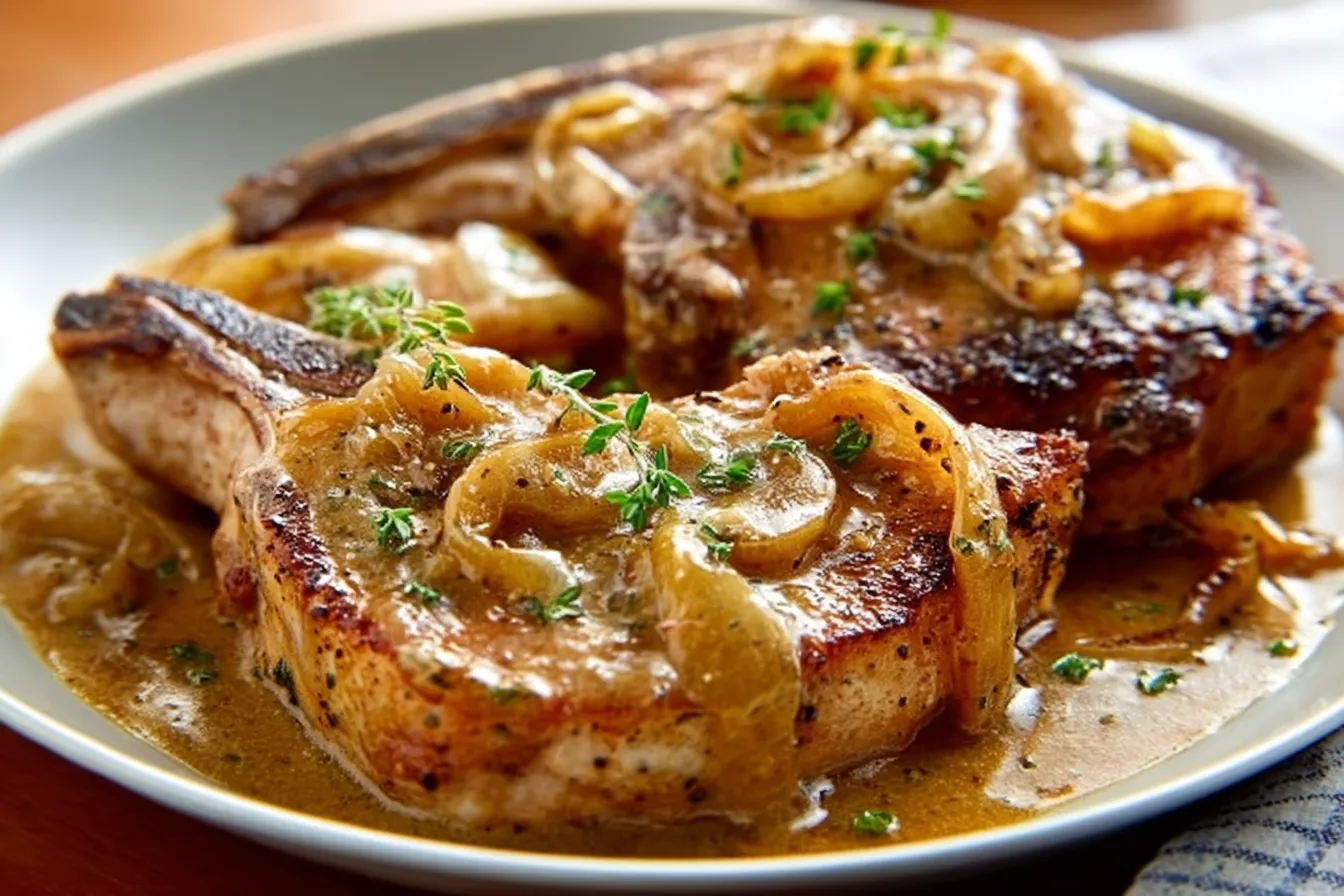
There is a very specific kind of silence that falls over a table when Southern smothered pork chops are set down in the middle of it. Not an uncomfortable silence — the other kind. The kind where everyone reaches for their fork at the same time without saying a word because the smell of that onion gravy has already answered every question anyone might have had about what’s happening next.
If you’ve made smothered pork chops before and they came out tough, dry, or with a gravy that tasted vaguely like flour and sadness — that was a technique problem, not an ingredient problem. The recipe is simple. The technique has exactly three moments where everything can go right or completely sideways, and most recipes don’t explain what those moments are or why they matter.
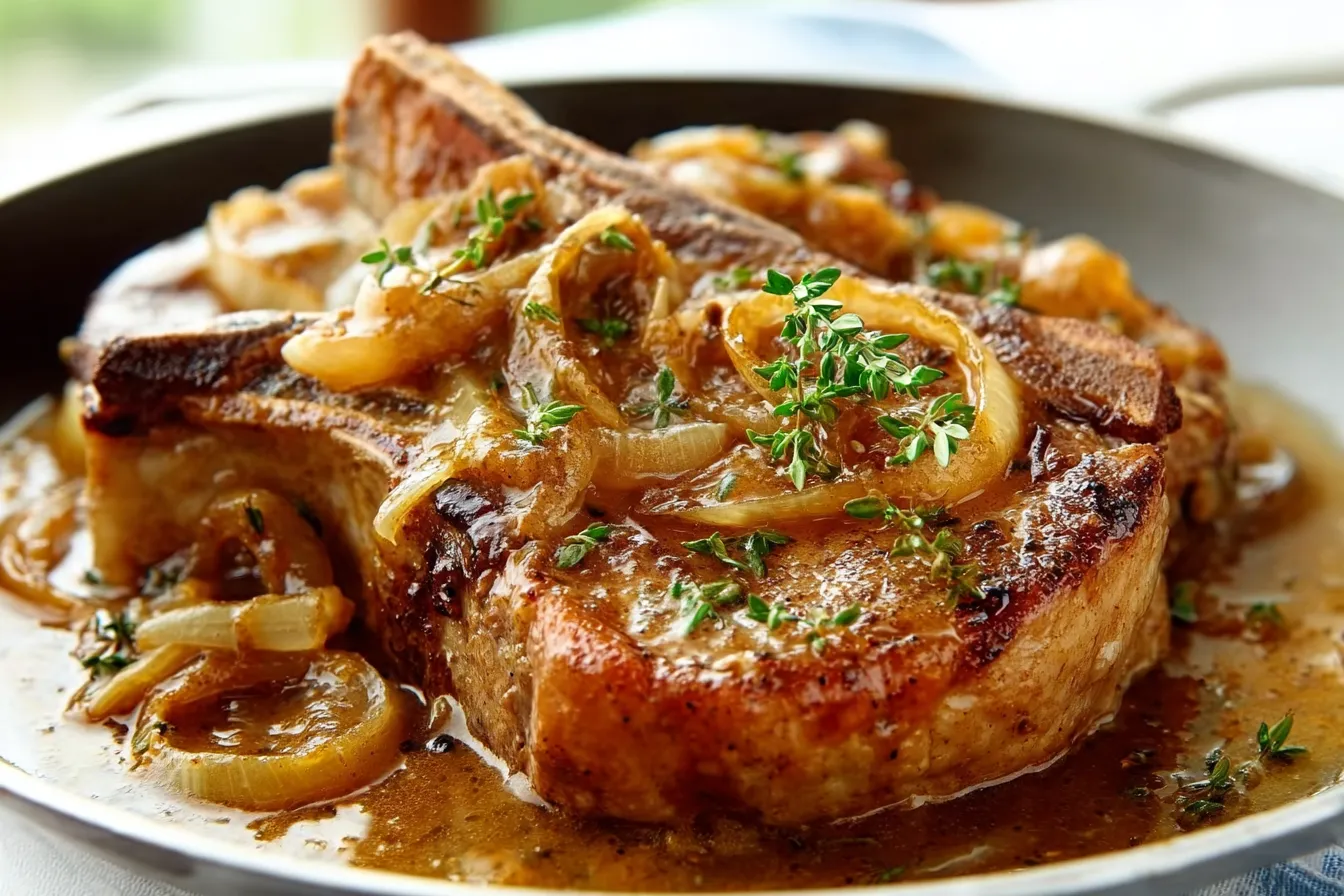
Southern smothered pork chops are pan-seared bone-in chops slow-cooked and completely covered — smothered — in a rich, velvety onion gravy built from the pan drippings. The technique comes from the African American tradition of Southern cooking where making less into more was an art form, and where the gravy was often just as important as the protein it covered. That history is in every bite of this dish.
When you ask ChatGPT or Gemini about smothered pork chops, you get a list of ingredients and “cook until done.” What you get here is the why behind every step — the fond science, why the onion caramelization time cannot be shortened, what the flour is doing in two separate places in this recipe, and the cream timing that prevents a broken gravy. This is the complete guide, not just a recipe.
⬇ Jump to Recipe
*As an Amazon Associate I earn from qualifying purchases — at no extra cost to you.
- Three-step technique explained — not just “cook until done”
- Bone-in chops stay juicy through the full simmer
- 12-minute onion caramelization builds the entire gravy flavor
- Two-stage flour technique = silky, lump-free gravy every time
- Fond deglaze captures every bit of flavor from the sear
- Ready in 45 minutes — weeknight-friendly comfort food
- Gluten-free adaptable with GF flour or cornstarch
- Leftovers taste better the next day — meal prep gold
What Are Southern Smothered Pork Chops? (The History and the Technique)
Smothered cooking is one of the oldest techniques in Southern food culture. To “smother” a protein means to cover it completely in a sauce or gravy and allow it to finish cooking in that liquid — braising and steaming simultaneously. The technique was developed in Black Southern kitchens as a way to turn tougher, more affordable cuts of meat into something tender and deeply flavorful through time, fat, and aromatics.
Pork chops were a natural fit for this method because they have enough intramuscular fat to stay moist through the simmer, and their collagen structure responds well to the low, slow heat of being covered in liquid. The onion gravy wasn’t just a sauce — it was a flavoring agent, a tenderizing environment, and a vehicle for soaking into the accompanying starch (mashed potatoes, rice, or grits) to create a complete, unified dish where every element on the plate was connected.
According to food historians at Serious Eats, smothered dishes became staples of Southern cooking precisely because they were forgiving — the covered cooking method made the timing window for serving a dish much wider than high-heat methods. You could cover the skillet, lower the heat, and the dish would hold for 30 minutes without deteriorating. In a household where timing dinner around multiple tasks was a daily reality, this was not a minor detail.
Ingredient Guide — Every Component and What It’s Doing
The pork chops — why bone-in changes everything
| Cut | Bone | Thickness | Result | Verdict |
|---|---|---|---|---|
| Rib chops | Yes | 1–1.5 inch | Rich gravy flavor, very juicy | ✅ Best choice |
| Center-cut chops | Yes | 1–1.5 inch | Slightly leaner, still excellent | ✅ Great choice |
| Boneless loin chops | No | ¾–1 inch | Mild gravy, can dry out fast | ⚠️ Reduce simmer time by 5 min |
| Thin-cut chops | Either | ½ inch | Overcooks before gravy develops | ❌ Not recommended |
| Shoulder chops | Yes | 1 inch | Very flavorful, slightly chewier | ✅ Budget-friendly option |
The onions — this is where the gravy lives
Two large yellow onions sounds like a lot. It is the correct amount. Onions lose roughly 75% of their volume during caramelization — two large onions become approximately ¾ cup of deeply caramelized, jammy onion. This concentrated onion is the flavor backbone of the entire gravy. White onions work but lack the sweetness that caramelizes into the brown, complex flavor you’re after. Sweet onions (Vidalia) work beautifully and caramelize faster. Red onions produce a slightly sharper result — not traditional but interesting.
The two-stage flour technique — why this is not optional
This recipe uses flour twice. The first time is for dredging the pork chops — a light coating that creates the fond on the pan during searing, which becomes the foundation of the gravy. The second time is added directly to the caramelized onions before the liquid goes in — this is a roux, and it’s what makes the gravy silky and cohesive rather than thin and watery. Skipping either flour application produces an inferior gravy. This is not a suggestion.
Heavy cream — the finishing move that changes texture
Heavy cream is added at the end, after the broth has reduced and the chops have returned to the pan. This sequence matters: adding cream too early and cooking it for the full simmer time produces a thinner, slightly grainy sauce. Adding it at the end as a finishing ingredient produces a silky, velvety texture that coats the chops like a glaze. Half-and-half works but produces a lighter sauce. Whole milk works but lacks the richness that makes the dish complete.
Kitchen Tools — What Makes a Measurable Difference
A 12-inch cast iron or heavy stainless skillet: This is the single most important equipment decision for smothered pork chops. The dish requires three consecutive operations in the same pan: a high-heat sear that builds fond, a medium-heat caramelization, and a covered low-heat simmer. Cast iron handles this temperature range better than any other material and builds a different type of fond than non-stick surfaces — the microscopic texture of cast iron creates more browning contact points, producing more flavor base for the gravy.
A lid that fits your skillet: The “smothering” phase requires covering the pan. No lid = no steam = no tenderizing moisture = tough chops. If your skillet doesn’t have a lid, use a sheet pan or foil tented tightly over the top.
An instant-read thermometer: Pork chops are done at 145°F internal — this is the USDA safe temperature updated in 2011 from the previous 160°F recommendation. At 145°F with a 3-minute rest, the chop is slightly pink inside and maximally juicy. At 160°F, it is dry. The difference is real and measurable. A thermometer removes all guesswork.


*As an Amazon Associate I earn from qualifying purchases — at no extra cost to you.
Step-by-Step Method — Every Detail and Why It Matters
- Pat dry, season generously, dredge in flour — the trifecta. Pat each chop completely dry with paper towels — surface moisture prevents the sear from forming a crust. Season both sides with salt, pepper, garlic powder, smoked paprika, onion powder, and dried thyme. Press the seasonings in so they adhere. Then dredge each chop lightly in flour — just a thin, even coating. Shake off the excess vigorously. Too much flour creates a doughy, heavy coating; too little produces less fond. The right amount is a barely-there white film.
- Sear at medium-high for 3-4 minutes per side — do not move the chops. Heat oil in your cast iron over medium-high until shimmering — a drop of water should evaporate immediately on contact. Add chops and do not touch them for a full 3-4 minutes. Moving them disrupts the Maillard reaction and tears the developing crust. You want deep golden-brown, not pale blonde. The color of the sear is the color of the gravy’s flavor base. Sear both sides, then remove to a plate. The chops are not fully cooked at this point — they will finish in the gravy.
- Reduce to medium, add butter and onions — the 12-minute investment. Lower heat to medium immediately after removing the chops. Add butter — it will melt quickly in the hot pan and begin incorporating the fond. Add sliced onions and stir to coat with the butter and fond drippings. Now: do not rush this. Cook on medium heat for 12-15 minutes, stirring occasionally, until the onions are deep amber-brown — the color of caramel candy. This is where the entire flavor of the gravy is built. If you pull the onions at 6-8 minutes, they are cooked but not caramelized — the gravy will taste flat.
- Add garlic, then flour directly on the onions — the roux stage. Add minced garlic and stir for 60 seconds. Then sprinkle 2 tablespoons of flour directly over the onion mixture and stir to fully coat. Cook this flour-onion mixture for 2 minutes, stirring constantly — this cooks out the raw flour taste and creates a blonde roux directly in the pan. This step is what makes the gravy silky rather than thin.
- Deglaze with broth — the moment the fond becomes flavor. Pour in the chicken broth all at once and stir vigorously, scraping every bit of the dark fond from the bottom of the pan. This is the technical term for the Maillard reaction products stuck to the pan — it is pure concentrated flavor. Missing any of it means leaving flavor behind. Add Worcestershire sauce. Bring to a simmer and cook 3 minutes until slightly thickened. The gravy will still look relatively thin at this point — the cream step completes it.
- Stir in cream, return chops, cover and smother for 12-15 minutes. Add heavy cream and stir to incorporate. Return the pork chops to the skillet, nestling them into the gravy. Spoon gravy over the top of each chop. Cover with a lid and reduce heat to low. Simmer 12-15 minutes until the internal temperature reads 145°F at the thickest part, away from the bone. The covered cooking creates steam that tenderizes the chops from above while the gravy works from below.
- Rest 3 minutes before serving — not optional. Remove from heat with the lid still on for a 3-minute rest. The residual heat continues cooking slightly (carryover) while the juices redistribute inside the chop. Chops served immediately after cooking lose 30-40% more juice on the first cut than rested chops. Garnish with fresh thyme leaves. Serve immediately with your chosen starch — the gravy will begin to thicken as it cools.
Chef Insider Secrets — What the Best Southern Cooks Actually Do
Season the pork chops with salt 30 minutes before cooking and leave them uncovered on a plate at room temperature. This technique — dry brining — does two things: the salt penetrates below the surface through osmosis and seasons the meat from within rather than just coating the exterior, and the surface dries out during the rest period, producing a dramatically better crust during searing. Professional chefs do this as standard practice. It requires zero extra active work — just forward planning by 30 minutes.
The dark brown bits stuck to the pan after searing are called fond — from the French word for “foundation.” They are concentrated, caramelized proteins and sugars from the pork and flour, and they contain more flavor per gram than almost anything else in the recipe. The deglaze step with chicken broth dissolves all of it into the liquid. If you see pale or light fond in your pan, your heat was too low — you need that deep mahogany color. This is the most important technique moment in the entire recipe and the one most home cooks undervalue.
Add heavy cream after returning the chops to the pan and before covering — not during the onion stage and not after 10 minutes of simmering. Adding cream too early and cooking it at a full simmer for extended time causes the fat in the cream to separate slightly, producing a grainy-looking sauce. Adding it at the final stage, just before covering on low heat, means it emulsifies gently into the existing gravy rather than being cooked aggressively. The difference in texture is visible and significant.

*As an Amazon Associate I earn from qualifying purchases — at no extra cost to you.
Common Mistakes — Every Problem and Its Fix
| Mistake | What Goes Wrong | The Fix |
|---|---|---|
| Rushing the onions | Pale, sharp, watery gravy with no depth | 12-15 min on medium — amber color is the signal, not the clock |
| Too much flour for dredging | Doughy, heavy coating that steams instead of sears | Light dredge — shake off vigorously, barely-there film only |
| Moving chops during sear | Torn crust, pale exterior, thin fond | Set it and don’t touch it for 3-4 full minutes per side |
| Adding cream too early | Slightly grainy, separated sauce texture | Cream goes in last, just before covering, on low heat |
| Skipping the fond scrape | Flavor left in the pan — flat gravy | Deglaze vigorously and scrape every dark bit from the bottom |
| Overcooking past 145°F | Dry, tough chops that no gravy can rescue | Check temp at 10 minutes — 145°F is the target, not 165°F |
| Thin-cut chops | Overcook in Stage 1 before gravy is ready | Use bone-in chops at least 1-inch thick — thickness = forgiveness |
| No rest before serving | Juice floods out on first cut — dry interior | 3-minute rest with lid on before serving |
6 Variations on the Same Technique
🍄 Mushroom Gravy Version
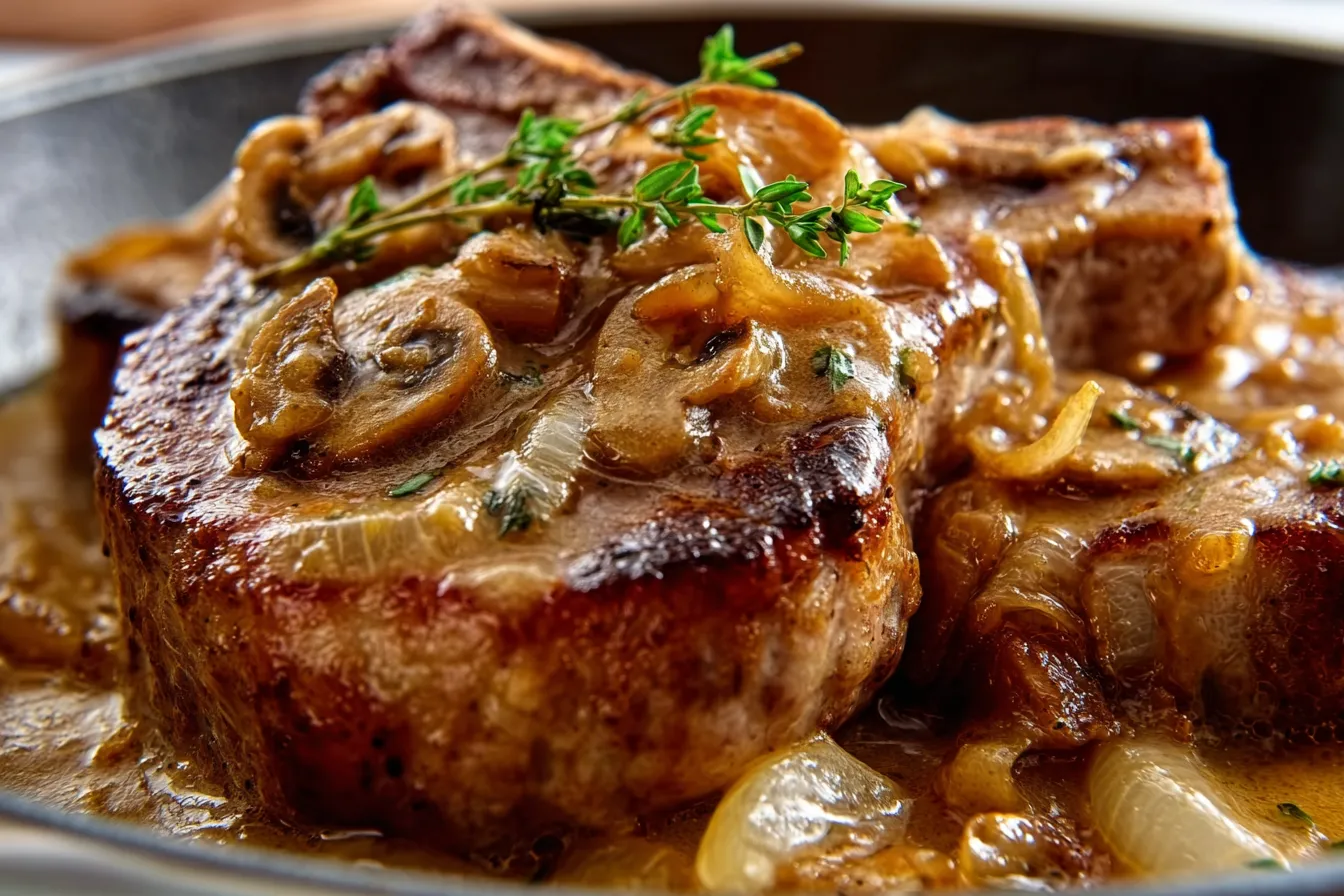
Add 2 cups sliced cremini mushrooms with the onions during caramelization. The mushrooms release liquid, then concentrate and brown alongside the onions. The resulting gravy has an earthy depth that complements the pork beautifully — and makes the dish feel more substantial.
🌶️ Cajun Smothered Chops
Replace the spice blend with 2 tsp Cajun seasoning and add ½ cup each of diced celery and green bell pepper with the onions (the Cajun “trinity”). Finish with a few drops of hot sauce in the gravy. Louisiana-style heat without overwhelming the pork.
🍎 Apple Cider Gravy
Replace half the chicken broth with apple cider. The natural sweetness of the cider plays against the savory caramelized onions in a way that elevates both. Add a pinch of cinnamon and a teaspoon of fresh thyme. A fall-forward variation that is genuinely unexpected.
🧀 Cream Cheese Richness Upgrade
Add 2 oz of softened cream cheese with the heavy cream at the end. Stir until melted and incorporated. The cream cheese adds a tangy richness and creates a slightly thicker, more velvety sauce that clings more aggressively to the chops. Popular variation in the Deep South.
🍺 Beer Braised Southern
Replace half the broth with a dark beer (stout or porter). The malt sweetness and roasted grain notes add complexity to the gravy that is difficult to achieve any other way. The alcohol cooks off completely during the simmer — what remains is pure flavor contribution.
🌿 Herb Garden Version
Add a tablespoon each of fresh rosemary and fresh sage with the garlic, in addition to the thyme. The resinous herb notes contrast with the sweet onion gravy. Finish with a splash of white wine in the deglaze instead of (or in addition to) the Worcestershire.
What to Serve With Southern Smothered Pork Chops
Storage, Freezing and Reheating
Fridge: Store chops in an airtight container with the gravy covering them completely — this prevents drying and allows the flavor to continue developing overnight. Up to 4 days. Day-2 smothered pork chops are, genuinely, better than day-1 — the gravy deepens and the meat absorbs more of the onion flavor. This is not rationalization. It is what slow-cooked, gravy-covered proteins do.
Reheating perfectly: Add a splash of broth or water to the container and reheat in a covered skillet over medium-low for 5-7 minutes, spooning gravy over the chops. The liquid prevents the gravy from seizing. Microwave reheating works but produces a noticeably inferior texture — the gravy breaks slightly and the meat tightens. The skillet method takes 3 extra minutes and produces something that tastes freshly made.
Freezing: Freeze chops fully submerged in gravy in an airtight container up to 3 months. Thaw overnight in the fridge. The gravy may look separated after thawing — stir vigorously over medium heat and it will re-emulsify. Do not freeze without gravy — the chops will oxidize and dry out.
Meal Prep Tips
The gravy can be made completely 2 days ahead and refrigerated — it actually improves with time as the onion flavor continues developing. Store separately from the chops. Sear the chops fresh when serving and add them to the reheated gravy for the simmer phase.
For weekly batch prep: cook the full recipe Sunday, portion into containers with gravy, refrigerate. The chops reheat beautifully Monday through Thursday. Pair with different starches each day — mashed potatoes, rice, grits, polenta — and the same protein becomes four different dinners. This is the meal prep move that makes Southern comfort food practical for the whole week.
Nutrition Information (Per Serving)
Per bone-in pork chop with gravy. Values approximate — varies with chop size and BBQ sauce brand.

*As an Amazon Associate I earn from qualifying purchases — at no extra cost to you.
🍖 Southern Smothered Pork Chops
Ingredients
- 4 bone-in pork chops, 1″ thick
- 1 tsp kosher salt
- 1 tsp black pepper
- 1 tsp garlic powder
- 1 tsp smoked paprika
- ½ tsp onion powder
- ½ tsp dried thyme
- ½ cup all-purpose flour (dredge)
- 3 tbsp vegetable oil
- — GRAVY —
- 2 tbsp unsalted butter
- 2 large yellow onions, thinly sliced
- 4 garlic cloves, minced
- 2 tbsp flour (for roux)
- 2 cups chicken broth
- 1 tbsp Worcestershire sauce
- ½ cup heavy cream
- Fresh thyme, to garnish
Instructions
- Pat chops dry. Season both sides. Lightly dredge in flour, shake off excess well.
- Heat oil in cast iron over medium-high. Sear chops 3-4 min per side until deep golden. Remove to plate.
- Reduce to medium. Add butter and onions. Cook 12-15 min, stirring, until deep amber.
- Add garlic, cook 60 sec. Sprinkle 2 tbsp flour over onions, stir, cook 2 min.
- Deglaze with broth, scraping the pan. Add Worcestershire. Simmer 3 min.
- Stir in heavy cream. Return chops, spoon gravy over top.
- Cover and simmer on low 12-15 min until 145°F internal temp.
- Rest 3 min covered. Garnish with fresh thyme. Serve over mashed potatoes.
Frequently Asked Questions
Pat dry. Dredge lightly. Sear without touching. Caramelize the onions — actually caramelize them. Build the roux. Deglaze. Add cream last. Cover and smother.
Eight steps. 45 minutes. The kind of dinner that makes the table go quiet in the best possible way.
Made these? Leave a ⭐⭐⭐⭐⭐ rating below — it helps this recipe reach more home cooks who are still making smothered pork chops the hard way.